
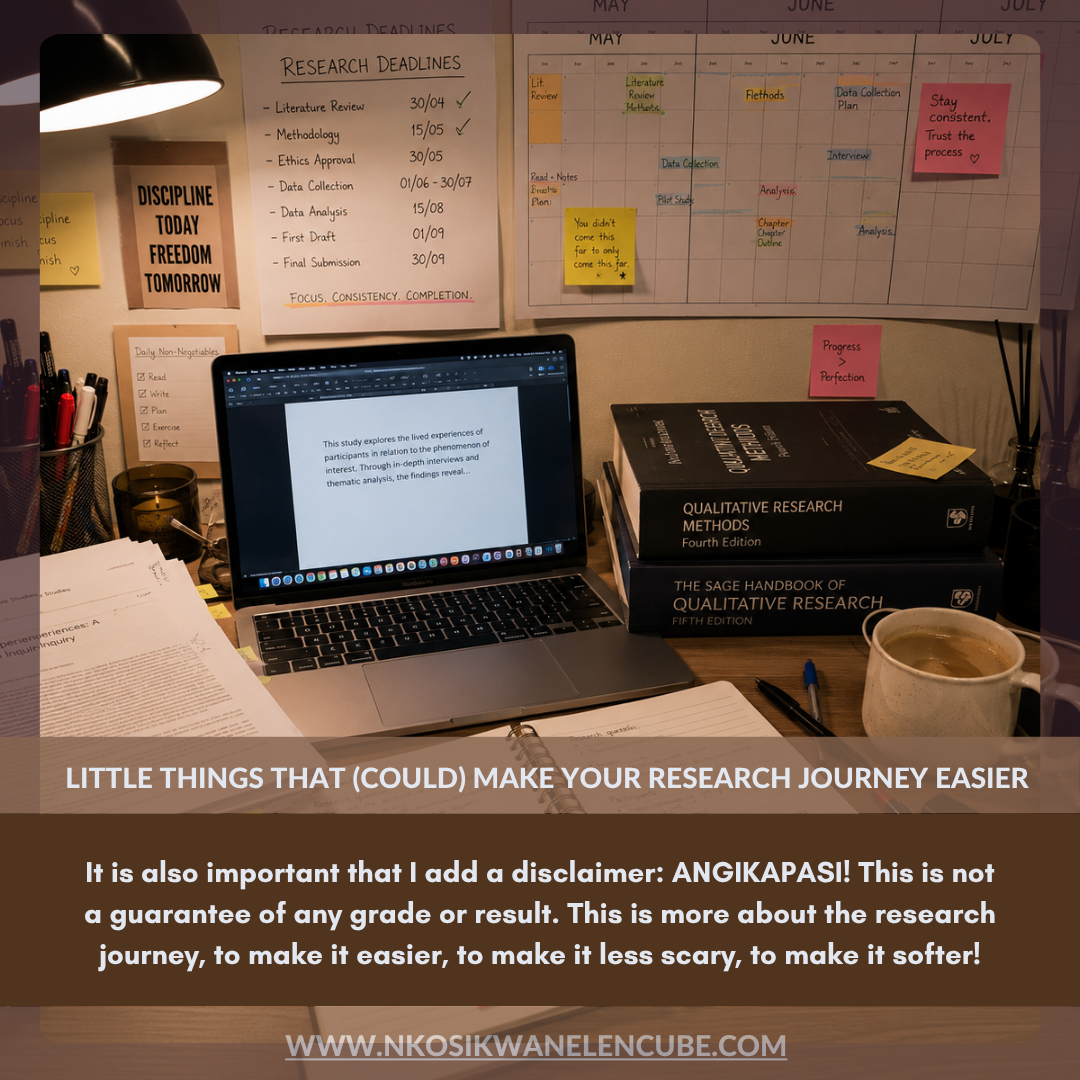
I am in the last quarter of my Masters degree and for the first time since I started, doubt is starting to creep . Is my research good enough? Does it even make sense before we get to it being good? How would it translate to an examiner? Suddenly, an anxiety that I haven’t felt for years is back. But it could be worse. I know what I look like when my anxiety has permanently moved in. And we are not there yet. So I must be doing something right. Something is making this process smoother than it otherwise would be. Let me appropriate my #bff’s (READ HER BLOG HERE OR SO HELP ME!) current favourite phrase and suggest ways to make your (and my) research journey softer.
- STUDY SOMETHING YOU ACTUALLY ENJOY
I can not stress this enough. It is so important that whatever your research area , your interest is piqued. You are going to be stuck with this thing for one or two whole years. I promise you, you don’t want to be dragging your feet every time. Eventually, you will lose interest.
I love movies, and I love blaming colonialism for everything wrong in my life (because duh). And at the intersection of those two things, I found my research topic. I did my undergrad at a time when I was so obsessed with reality TV and my research was about reality TV. I was excited about it from the beginning.
So on days when the will to study is not there, I am carried by my interest in the field of study, and sometimes those days are the best. Naturally, what happens when you start enjoying it is that it stops being a chore. It stops being something you have to do and becomes something you get to. That little difference actually makes a world of difference, - APPROACH WITH CURIOSITY
I know when you embark on research, you usually have an inkling of what direction it will take, and that’s okay. But don’t overcommit to what you think it should be. Don’t arm wrestle the literature to make your point, or arm wrestle your findings to say what you want them to. It’s important to get okay with your research evolving as you go. That’s why you’re doing it in the first place. To discover things you didn’t know before. So don’t be precious about what you thought would turn out; instead, be curious about what could be, that’s where the learning is. - YOU NEED A SUPPORT SYSTEM
Your first point of contact here would be your supervisor. I am so lucky to have the most present, most interested, and most resourceful supervisor. She is so gentle with me and believes in me. A huge part of why I want my research to go well is for this woman who has poured so much into me.
I understand not everyone has this privilege, so it’s also important to cultivate a support system beyond your supervisor. My friends hold me accountable all the time. I was feeling a little lazy last week and asked them to bully me into reaching my word count for the day. They did. Lindzy even put her mum on the phone to remind me I wasn’t at school to play. Make it a community project, how many people outside yourself have you made stakeholders to this thing that you are doing? The more stakeholders you rope in, the more support you are likely to get. - BRING IT UP SOCIALLY
Don’t be a douche about it, but bring it to people outside your area of focus. The last person to read my proposal before I submitted it was my sister. Now my sister is a chartered accountant with no horse in the humanities race. What I needed from her was to be sure if it made sense to someone with no humanities background. And because it’s a basic understanding for her, she will easily pick out where there are gaps in reasoning. Someone in your field wouldn’t necessarily notice those gaps, they take them for granted. - LET IT (AND YOU) BREATHE
You will burn out. I am circling the burnout drain as we speak. I have had an intense couple of weeks and still have a few more intense ones coming. It is time for a breather. I think of this as a marathon and not a sprint. So it is perfectly okay to take a water break now and then.
Our water break isn’t a complete disengagement from the race; it means we slow down a bit. Take your eyes away from the literature for a bit, and do small language edits to the work you have done. Take a week to do light brain work. Press pause on the chapter, transcribe your interviews. Your cadence can not be the same throughout the entire process so allow yourself to breathe.
These are the things that have made the past year-plus softer for me. They are not gospel truth, but they work for me. It is also important that I add a disclaimer: ANGIKAPASI! This is not a guarantee of any grade or result. This is more about the research journey, to make it easier, to make it less scary, to make it softer!


Me I knows WE are passing this!